
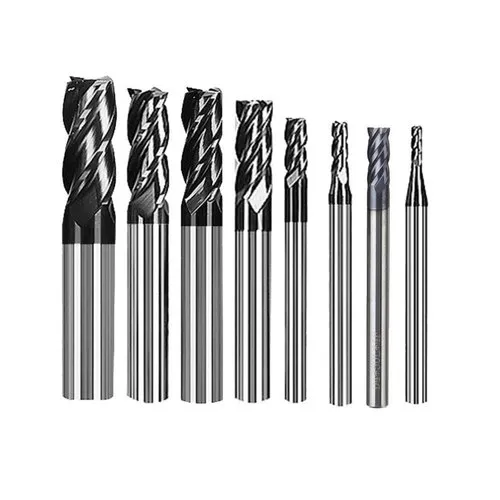
Are you tired of wasting money on endmills that don’t deliver the performance you need for your construction projects? In the competitive world of hardware export and construction, choosing the right cutting tools can make or break your project’s success and profitability.
The solution lies in understanding the fundamental differences between HSS (High-Speed Steel) and carbide endmills. These two types of milling tools serve distinct purposes in construction applications, and making the wrong choice can lead to increased costs, project delays, and subpar results.
Also read – Ultimate Guide: Drilling Tips for Precise Holes in Jewelry Making for Hardware & Construction Pros
What Are HSS and Carbide Endmills?
HSS endmills are cutting tools made from high-speed steel, a specialized tool steel that maintains its hardness at high temperatures. Carbide endmills, on the other hand, are manufactured from tungsten carbide, a composite material known for its exceptional hardness and wear resistance.
How They Are Made: From Raw Material to Finished Product
Raw Materials
HSS endmills primarily use tungsten, molybdenum, chromium, and vanadium alloy steels. Carbide endmills utilize tungsten carbide particles bonded with cobalt as the primary material.
Manufacturing Process
HSS manufacturing involves melting the alloy components in electric arc furnaces, followed by hot rolling and forging into bar stock. The bars are then machined into endmill shapes using CNC machines, followed by heat treatment processes including hardening and tempering.
Carbide endmills begin with powder metallurgy, where tungsten carbide and cobalt powders are mixed, pressed into green compacts, and sintered at high temperatures. The resulting carbide blanks are then ground to precise dimensions using diamond grinding wheels.
Key Properties Derived from Manufacturing
HSS endmills gain toughness and shock resistance from their manufacturing process, making them ideal for interrupted cuts and varying material conditions. Carbide endmills achieve superior hardness and wear resistance through the sintering process, allowing them to maintain sharp cutting edges longer.
Quality Control
Both types undergo rigorous quality checks including dimensional accuracy verification, hardness testing, surface finish inspection, and cutting performance validation according to international standards like ISO and ANSI.
Performance Comparison: Key Differences
HSS endmills excel in applications requiring flexibility and shock resistance. They can withstand interrupted cuts and are more forgiving when machining uneven surfaces. According to Machining Doctor, HSS tools typically operate at lower cutting speeds but offer better toughness.
Carbide endmills provide superior performance in high-volume production and hard materials. They maintain cutting efficiency at higher speeds and temperatures, making them ideal for continuous machining operations.
Essential Uses in the UAE Construction Landscape
In the UAE’s booming construction sector, HSS endmills are primarily used for general-purpose milling of structural steel, aluminum framing, and wood components. Their shock resistance makes them perfect for on-site modifications and repair work.
Carbide endmills find their niche in precision work with hard materials like reinforced concrete, stone, and composite materials commonly used in modern UAE architecture. Their wear resistance ensures consistent performance in high-volume production environments.
Cost Considerations and ROI
While carbide endmills have a higher initial cost, their longer tool life often results in lower cost per part in high-volume applications. HSS endmills offer better value for low-volume jobs and applications where tool breakage is a concern.
Choosing the Right Supplier in Dubai
When selecting endmill suppliers in Dubai, consider factors like product quality, technical support, inventory availability, and after-sales service. Look for suppliers who understand the unique demands of the UAE construction market and can provide expert guidance on tool selection.
Trusted Partner for Your Construction Tool Needs
For hardware shopkeepers and construction professionals in the UAE, AL MIFTHAAH BUILDING & CONSTRUCTION MATERIALS TRADING CO LLC stands as a reliable partner for all your cutting tool requirements. Located in Al Fahidi Bur Dubai, this established company has built a reputation for supplying high-quality construction tools that meet the rigorous demands of the UAE market.
AL MIFTHAAH specializes in providing premium ABRASIVES, DRILLING TOOLS, MACHINE TOOLS ACCESSORIES, and MILLING TOOLS from trusted international brands. Their extensive inventory ensures that construction companies and hardware retailers can access the right tools for any application, whether it’s high-rise construction, infrastructure development, or specialized fabrication work.
The company’s commitment to quality and customer satisfaction makes them the go-to supplier for construction professionals who cannot afford tool failure or performance issues. With their expertise in both HSS and carbide endmills, they can help you select the perfect tools for your specific applications, ensuring optimal performance and cost efficiency.
Visit their website at https://almifthaahbacmtrading.com/ to explore their comprehensive range of construction tools and accessories.