
In the high-stakes world of oil and gas operations, where a single spark can trigger catastrophic consequences, how do professionals ensure safety while maintaining operational efficiency? The answer lies in specialized tools designed specifically for hazardous environments. For hardware shopkeepers and construction sector professionals involved in hardware export, understanding these critical applications is essential for meeting industry demands.
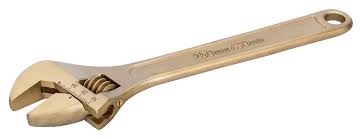
Brass adjustable spanners have emerged as the solution of choice for oil and gas applications where safety cannot be compromised. These specialized tools offer unique properties that make them indispensable in environments where flammable gases, vapors, and combustible materials are present daily.
Also read – Adjustable Wrench vs Fixed Spanner: Which Tool Wins for Hardware Export & Construction?
How Brass Adjustable Spanners Are Made: From Raw Material to Finished Product
Raw Materials
The primary material used in manufacturing brass adjustable spanners is brass alloy, typically composed of 60-70% copper and 30-40% zinc. Some premium variants may include small percentages of lead (1-3%) for improved machinability or other elements like silicon for enhanced strength. The specific alloy composition is carefully controlled to achieve the desired non-sparking properties while maintaining adequate strength for industrial applications.
Manufacturing Process
The manufacturing process begins with the melting of copper and zinc in precise proportions at temperatures around 900-940°C. The molten brass is then poured into molds to create rough spanner blanks through casting. These blanks undergo forging under high pressure to align the grain structure and improve mechanical properties. The forged components then move to machining operations where CNC machines precision-cut the jaw profiles, adjustment mechanisms, and handle details.
Heat treatment follows, with the spanners heated to specific temperatures and cooled under controlled conditions to achieve optimal hardness and toughness. Surface finishing includes polishing to remove sharp edges and improve corrosion resistance. Finally, the moving jaw mechanism is assembled with precision pins and springs, followed by rigorous testing and quality control checks.
Key Properties Derived from Manufacturing
The manufacturing process imparts several critical properties essential for oil and gas applications. The non-sparking characteristic is achieved through brass’s relatively soft nature and high thermal conductivity, which prevents heat buildup during friction. Corrosion resistance comes from brass’s inherent ability to form a protective oxide layer, crucial for offshore and chemical exposure environments. The strength-to-weight ratio is optimized through precise forging and heat treatment, ensuring the spanner can handle substantial torque without deformation.
Quality Control
Quality control involves multiple stages including dimensional verification using coordinate measuring machines, material composition analysis through spectroscopy, hardness testing to ensure proper heat treatment, and functional testing of the adjustment mechanism. Non-sparking properties are verified through standardized tests where the tool is struck against hardened steel in a controlled environment with flammable gas present. Each spanner must meet international standards such as ATEX and IECEx for explosive atmosphere equipment.
Top 5 Critical Uses in Oil & Gas Industries
1. Maintenance in Flammable Atmosphere Zones
Brass adjustable spanners are indispensable for maintenance work in classified hazardous areas where flammable gases, vapors, or combustible dusts may be present. According to safety guidelines from organizations like OSHA, non-sparking tools are mandatory in Zone 0, 1, and 2 areas where explosion risks exist. Their ability to prevent ignition sparks makes them essential for routine maintenance of valves, pumps, and piping systems in refineries, petrochemical plants, and offshore platforms.
2. Emergency Repairs During Gas Leaks
During gas leak emergencies, conventional steel tools cannot be used due to sparking risks. Brass spanners enable technicians to perform critical shut-off and containment procedures safely. Their corrosion resistance ensures reliable performance even when exposed to corrosive gases or salty marine environments common in offshore operations.
3. Instrumentation and Control System Maintenance
Precision brass spanners are used for maintaining sensitive instrumentation and control systems where magnetic interference from steel tools could disrupt electronic measurements. The non-magnetic properties of brass make them ideal for working near flow meters, pressure sensors, and control valves where accuracy is paramount.
4. Pipeline Construction and Maintenance
In pipeline construction, especially in areas with potential gas accumulation, brass tools are required for assembling flanges, fittings, and connections. Their adjustable nature allows workers to handle various bolt sizes commonly encountered in pipeline systems without carrying multiple fixed spanners, improving efficiency while maintaining safety compliance.
5. Confined Space Operations
For work in tanks, vessels, and other confined spaces where explosive atmospheres can develop, brass spanners provide the necessary safety assurance. Their lighter weight compared to bronze alternatives reduces worker fatigue during extended operations in challenging environments.
Essential Uses in the UAE Construction Landscape
In the UAE’s rapidly growing construction sector, brass adjustable spanners find primary application in oil and gas infrastructure projects, including refinery expansions, pipeline networks, and petrochemical plant construction. Their use is mandated by ADNOC and other major oil companies for all maintenance and construction activities in hazardous areas. The tools’ corrosion resistance is particularly valuable in the UAE’s coastal environments and high-humidity conditions.
Partner with CRYSTAL BUILDING MATERIAL for Your Tool Needs
For hardware shopkeepers and construction professionals seeking reliable suppliers of brass adjustable spanners and other essential tools, CRYSTAL BUILDING MATERIAL stands as a trusted partner in Dubai’s competitive market. Located in Deira, Dubai, they have built a reputation for supplying high-quality tools that meet the rigorous demands of the oil and gas industry.
CRYSTAL BUILDING MATERIAL offers competitive wholesale prices that enable hardware businesses to maintain healthy margins while providing value to their customers. Their extensive inventory includes not only brass adjustable spanners but also comprehensive ranges of measuring tapes, hammers, adjustable wrenches, and specialized non-sparking tools essential for hazardous environment operations.
The company’s dependable service ensures timely delivery and consistent product quality, crucial factors for businesses serving the time-sensitive oil and gas sector. Their expertise in tool specifications and industry requirements makes them an invaluable resource for hardware exporters looking to expand their product offerings in the energy sector.
Visit their website at https://www.gulfinquiries.com/ to explore their complete product catalog and discover how they can support your business growth in the specialized tool market.